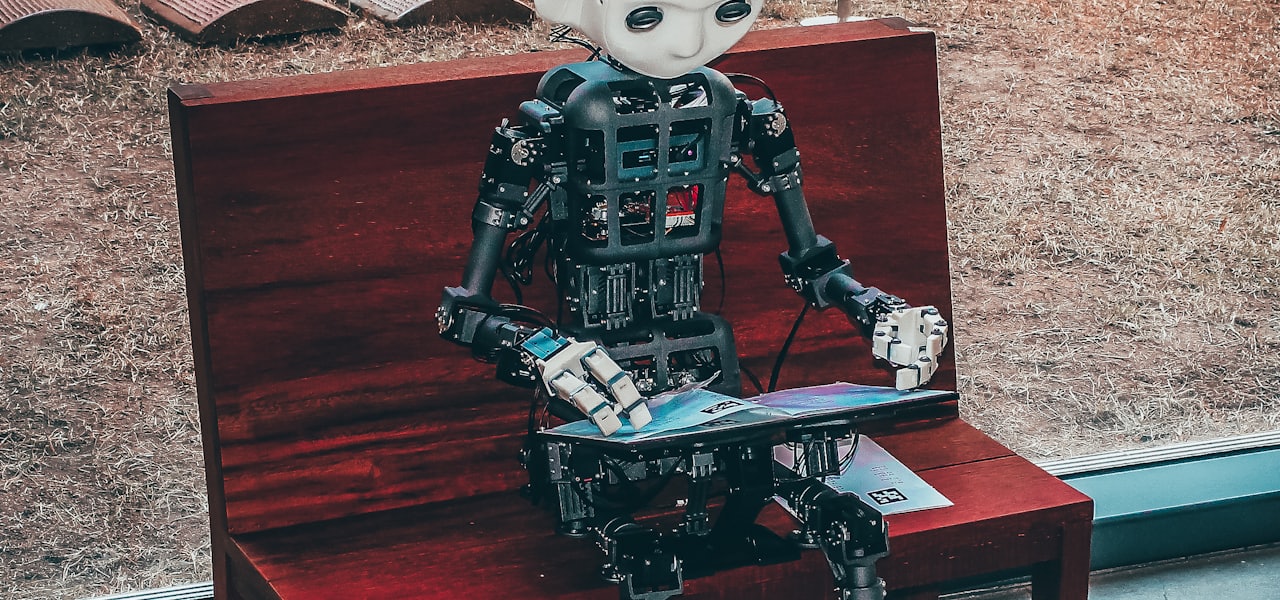
Ayanna MacCalla Howard (born January 24, 1972) is an American roboticist, entrepreneur, and educator currently serving as the dean of the College of Engineering at Ohio State University. Assuming this role in March 2021, Howard became the first woman to lead the Ohio State College of Engineering. Howard previously served as the chair of the School of Interactive Computing in the Georgia Tech College of Computing, the Linda J. and Mark C. Smith Endowed Chair in Bioengineering in the School of Electrical and Computer Engineering, and the director of the Human-Automation Systems (Humans) Lab. == Early life and education == As a little girl, Howard was interested in aliens and robots. Her favorite TV show was The Bionic Woman. Howard received her B.S. in engineering from Brown University in 1993 and her M.S. and Ph.D. in electrical engineering from the University of Southern California in 1994 and 1999, respectively. Her thesis, Recursive Learning for Deformable Object Manipulation, was advised by George A. Bekey. In addition, Howard's Doctoral thesis was triggered by the AIDS epidemic with focus on sorting hospital waste by using robots. Howard has also received an MBA from Claremont Graduate University. == Career == Howard's early interest in artificial intelligence led her to pursue a senior position at Seattle-based Axcelis Inc, where she helped develop Evolver, the first commercial genetic algorithm, and Brainsheet, a neural network developed in partnership with Microsoft. From 1993 to 2005, she worked at the NASA Jet Propulsion Laboratory, holding multiple roles such as senior robotics researcher and deputy manager in the Office of the Chief Scientist. In 2005, she joined Georgia Tech as an associate professor and founder of the Human-Automation Systems (Humans) lab. She has also served as the associate director of research for Georgia Tech's Institute for Robotics and Intelligent Machines and as chair of the multidisciplinary robotics Ph.D. program at Georgia Tech. In 2017, she became the chair of the School of Interactive Computing at Georgia Tech. In 2008, Howard received worldwide attention for her SnoMote robots, designed to study the impact of global warming on the Antarctic ice shelves. In 2013, she founded Zyrobotics, which has released their first suite of therapy and educational products for children with special needs. Howard has authored 250 publications in reputable journals and conferences, including serving as co-editor/co-author of more than a dozen books and book chapters. She has also received four patents and given over 140 invited talks and keynotes. She is a fellow of the Association for the Advancement of Artificial Intelligence (AAAI) and the Institute of Electrical and Electronics Engineers (IEEE). Among her many honors, Howard received the Computer Research Association's A. Nico Habermann Award and the Richard A. Tapia Achievement Award. In a 2020 interview on Marketplace, Howard outlined how companion robots could alleviate the effects of social distancing caused by the COVID-19 pandemic in the United States. On November 30, 2020, the Columbus Dispatch reported that Howard would become the next dean of the College of Engineering at Ohio State University on March 1, pending approval by the board of trustees. On March 1, 2021, she assumed this role, becoming the first woman to hold the position. In 2021, Howard received the Athena Lecturer Award from Association for Computing Machinery (ACM) for her Contributions to Robotics, AI and Broadening Participation in Computing. In June 2022, Howard was elected a trustee of Brown University. == Research == Howard's research interests include human-robot interaction, assistive/rehabilitation robotics, science-driven/field robotics, and perception, learning, and reasoning. Howard's research and published works span across various topics in robotics and AI, including intelligent learning, virtual reality for rehabilitation and robotics in the role of pediatric therapy. Her research is highlighted by her focus on technology development for intelligent agents that must interact with and in a human-centered world. Her work, which addresses issues of human-robot interaction, learning, and autonomous control, has resulted in more than 200 peer-reviewed publications. == Honors and awards == Howard's numerous accomplishments have been documented in more than a dozen featured articles. In 2003, she was named to the MIT Technology Review TR100 as one of the top 100 innovators in the world under the age of 35. She was featured in Time magazine's "Rise of the Machines" article in 2004. She was also featured in a USA Today Science & Space article. Some of Howard's notable awards include: Lew Allen Award for Excellence (formerly the Director's Research Achievement Award of the Jet Propulsion Laboratory) for significant technical contributions, 2001 MIT Technology Review Top 100 Young Innovators of the Year, 2003 NAE Gilbreth Lectureship, 2010 A. Richard Newton Educator ABIE Award, Anita Borg Institute, 2014 Computer Research Association's A. Nico Habermann Award, 2016 Brown Engineering Alumni Medal (BEAM), 2016 AAAS-Lemelson Invention Ambassador, 2016-2017 Atlanta magazine's Women Making a Mark, 2017 Walker's Legacy #WLPower25 Atlanta Award, 2017 Forbes America's Top 50 Women In Tech, 2018 ACM Athena Lecturer Award, 2021 2021 class of Fellows of the American Association for the Advancement of Science. IEEE Fellow, 2021, "for contributions to human-robot interaction systems" 2023 AAAI/EAAI Patrick Henry Winston Outstanding Educator Award
Transduction (machine learning)
In logic, statistical inference, and supervised learning, transduction or transductive inference is reasoning from observed, specific (training) cases to specific (test) cases. In contrast, induction is reasoning from observed training cases to general rules, which are then applied to the test cases. The distinction is most interesting in cases where the predictions of the transductive model are not achievable by any inductive model. Note that this is caused by transductive inference on different test sets producing mutually inconsistent predictions. Transduction was introduced in a computer science context by Vladimir Vapnik in the 1990s, motivated by his view that transduction is preferable to induction since, according to him, induction requires solving a more general problem (inferring a function) before solving a more specific problem (computing outputs for new cases): "When solving a problem of interest, do not solve a more general problem as an intermediate step. Try to get the answer that you really need but not a more general one.". An example of learning which is not inductive would be in the case of binary classification, where the inputs tend to cluster in two groups. A large set of test inputs may help in finding the clusters, thus providing useful information about the classification labels. The same predictions would not be obtainable from a model which induces a function based only on the training cases. Some people may call this an example of the closely related semi-supervised learning, since Vapnik's motivation is quite different. The most well-known example of a case-bases learning algorithm is the k-nearest neighbor algorithm, which is related to transductive learning algorithms. Another example of an algorithm in this category is the Transductive Support Vector Machine (TSVM). A third possible motivation of transduction arises through the need to approximate. If exact inference is computationally prohibitive, one may at least try to make sure that the approximations are good at the test inputs. In this case, the test inputs could come from an arbitrary distribution (not necessarily related to the distribution of the training inputs), which wouldn't be allowed in semi-supervised learning. An example of an algorithm falling in this category is the Bayesian Committee Machine (BCM). == Historical context == The mode of inference from particulars to particulars, which Vapnik came to call transduction, was already distinguished from the mode of inference from particulars to generalizations in part III of the Cambridge philosopher and logician W.E. Johnson's 1924 textbook, Logic. In Johnson's work, the former mode was called 'eduction' and the latter was called 'induction'. Bruno de Finetti developed a purely subjective form of Bayesianism in which claims about objective chances could be translated into empirically respectable claims about subjective credences with respect to observables through exchangeability properties. An early statement of this view can be found in his 1937 La Prévision: ses Lois Logiques, ses Sources Subjectives and a mature statement in his 1970 Theory of Probability. Within de Finetti's subjective Bayesian framework, all inductive inference is ultimately inference from particulars to particulars. == Example problem == The following example problem contrasts some of the unique properties of transduction against induction. A collection of points is given, such that some of the points are labeled (A, B, or C), but most of the points are unlabeled (?). The goal is to predict appropriate labels for all of the unlabeled points. The inductive approach to solving this problem is to use the labeled points to train a supervised learning algorithm, and then have it predict labels for all of the unlabeled points. With this problem, however, the supervised learning algorithm will only have five labeled points to use as a basis for building a predictive model. It will certainly struggle to build a model that captures the structure of this data. For example, if a nearest-neighbor algorithm is used, then the points near the middle will be labeled "A" or "C", even though it is apparent that they belong to the same cluster as the point labeled "B", compared to semi-supervised learning. Transduction has the advantage of being able to consider all of the points, not just the labeled points, while performing the labeling task. In this case, transductive algorithms would label the unlabeled points according to the clusters to which they naturally belong. The points in the middle, therefore, would most likely be labeled "B", because they are packed very close to that cluster. An advantage of transduction is that it may be able to make better predictions with fewer labeled points, because it uses the natural breaks found in the unlabeled points. One disadvantage of transduction is that it builds no predictive model. If a previously unknown point is added to the set, the entire transductive algorithm would need to be repeated with all of the points in order to predict a label. This can be computationally expensive if the data is made available incrementally in a stream. Further, this might cause the predictions of some of the old points to change (which may be good or bad, depending on the application). A supervised learning algorithm, on the other hand, can label new points instantly, with very little computational cost. == Transduction algorithms == Transduction algorithms can be broadly divided into two categories: those that seek to assign discrete labels to unlabeled points, and those that seek to regress continuous labels for unlabeled points. Algorithms that seek to predict discrete labels tend to be derived by adding partial supervision to a clustering algorithm. Two classes of algorithms can be used: flat clustering and hierarchical clustering. The latter can be further subdivided into two categories: those that cluster by partitioning, and those that cluster by agglomerating. Algorithms that seek to predict continuous labels tend to be derived by adding partial supervision to a manifold learning algorithm. === Partitioning transduction === Partitioning transduction can be thought of as top-down transduction. It is a semi-supervised extension of partition-based clustering. It is typically performed as follows: Consider the set of all points to be one large partition. While any partition P contains two points with conflicting labels: Partition P into smaller partitions. For each partition P: Assign the same label to all of the points in P. Of course, any reasonable partitioning technique could be used with this algorithm. Max flow min cut partitioning schemes are very popular for this purpose. === Agglomerative transduction === Agglomerative transduction can be thought of as bottom-up transduction. It is a semi-supervised extension of agglomerative clustering. It is typically performed as follows: Compute the pair-wise distances, D, between all the points. Sort D in ascending order. Consider each point to be a cluster of size 1. For each pair of points {a,b} in D: If (a is unlabeled) or (b is unlabeled) or (a and b have the same label) Merge the two clusters that contain a and b. Label all points in the merged cluster with the same label. === Continuous Label Transduction === These methods seek to regress continuous labels, often via manifold learning techniques. The idea is to learn a low-dimensional representation of the data and infer values smoothly across the manifold. == Applications and related concepts == Transduction is closely related to: Semi-supervised learning – uses both labeled and unlabeled data but typically induces a model. Case-based reasoning – such as the k-nearest neighbor (k-NN) algorithm, often considered a transductive method. Transductive Support Vector Machines (TSVM) – extend standard SVMs to incorporate unlabeled test data during training. Bayesian Committee Machine (BCM) – an approximation method that makes transductive predictions when exact inference is too costly.
Bidyut Baran Chaudhuri
Bidyut Baran Chaudhuri (B. B. Chauduri) is a senior computer scientist and an emeritus professor of Techno India University in West Bengal, India. He is also adjuncted to Indian Statistical Institute, where he was a professor for about three decades. He was the founding Head of Computer Vision and Pattern Recognition Unit (which was established in 1994) of ISI. Moreover, he was a J.C. Bose Fellow and Indian National Academy of Engineering Distinguished Professor at ISI. He was the vice-president of the Society for Natural Language Technology Research (SNLTR). His primary research contributes to the fields of computer vision, image processing and pattern recognition. He is a pioneer of "Indian language script OCR". == Education == Chaudhuri received his BSc (Hons.), BTech and MTech degrees from University of Calcutta, India in 1969, 1972 and 1974, respectively and PhD Degree from Indian Institute of Technology Kanpur in 1980. He did his post-doc work during 1981-1982 from Queen's University, U.K, through Leverhulme Overseas Fellowship. He also worked as a visiting faculty at Tech University, Hannover during 1986-87 as well as at GSF Institute of Radiation Protection (now Leibnitz Institute), Munich in 1990 and 1992. == Awards and recognition == Chaudhuri has been elected as a Life Fellow of IEEE "for contributions to pattern recognition, especially Indian language script OCR, document processing and natural language processing". He has become a Fellow of International Association for Pattern Recognition (IAPR) "for contributions to character recognition and speech synthesis in Indian language". He is also Fellow of The World Academy of Sciences (TWAS), Indian National Science Academy (INSA), Indian National Academy of Engineering (INAE), National Academy of Sciences (NASI), and Institute of Electronics and Telecommunication Engineering (IETE). In 2011, Chaudhuri received the Om Prakash Bhasin Award for his contribution in the field of electronics and information technology. Chaudhuri's interview on some of his works has been reported in Indian newspaper as well. He is within world's top 2% scientists and top-10 Indian AI scientists according to a study conducted by Stanford University. He has also been featured as top-10 machine learning researcher from India.
RE/flex
RE/flex (or RE-flex) is a computer program that generates lexical analyzers also known as "scanners" or "lexers". Lexical analysis is the process of converting an input character stream into a sequence of tokens, a task known as lexical tokenization. == Overview == Most notable lexer generators used in practice, including Flex, Ragel, and RE/flex are based on deterministic finite automata (DFA) for efficient pattern matching, despite the theoretical possibility of an exponential increase in DFA size. In practice, lexer specifications typically use deterministic regular expressions, which makes substantial DFA blowup uncommon. RE/flex translates a POSIX-compliant lexer specification directly into a DFA using standard construction techniques described in the compiler literature, extending the techniques to handle lazy matching and indentation detection applicable to specific programming language tokenization tasks. Like Flex, RE/flex generates efficient DFA-based scanners, but it shares no code with Flex and is implemented as a complete rewrite in C++. In addition to its native DFA-based engine, RE/flex can also be combined with external regular expression libraries that are not DFA-based, such as the C++ standard library regex engine, PCRE, and boost.regex. This is achieved by systematically rewriting the set of lexer patterns into a form suitable for tokenization with the selected external library. RE/flex performs this rewriting automatically using translation rules that are specific to each supported regular expression library. A lexer specification defines a set of regular expression patterns { p i : i = 1 , … , n } {\displaystyle \{p_{i}:i=1,\ldots ,n\}} corresponding to different token classes, such as identifiers, keywords, literals, and operators. These patterns can be combined into a single regular expression R = ( p 1 ) ∣ ( p 2 ) ∣ … ∣ ( p n ) {\displaystyle R=(p_{1})\mid (p_{2})\mid \ldots \mid (p_{n})} . When applied to an input string, a regular expression engine repeatedly matches R {\displaystyle R} , returning the index i of the matched subpattern ( p i ) {\displaystyle (p_{i})} , thereby decomposing the input into a sequence of tokens. Example use cases include: Compiler construction, such as the use of RE/flex in the Tiger Compiler project within the EPITA compiler construction curriculum Compiler-compiler systems, including its use in Ox, an attribute-grammar–based compiling system Pattern matching and search tools, such as grep-like utilities, including the use of RE/flex in ugrep
Stephen Muggleton
Stephen H. Muggleton (born 6 December 1959, son of Louis Muggleton) is Professor of Machine Learning and Head of the Computational Bioinformatics Laboratory at Imperial College London. == Education == Muggleton received his Bachelor of Science degree in computer science (1982) and Doctor of Philosophy in artificial intelligence (1986) supervised by Donald Michie at the University of Edinburgh. == Career == Following his PhD, Muggleton went on to work as a postdoctoral research associate at the Turing Institute in Glasgow (1987–1991) and later an EPSRC Advanced Research Fellow at Oxford University Computing Laboratory (OUCL) (1992–1997) where he founded the Machine Learning Group. In 1997 he moved to the University of York and in 2001 to Imperial College London. From 2025, Muggleton has joined Nanjing University as a full-time professor. == Research == Muggleton's research interests are primarily in Artificial intelligence. From 1997 to 2001 he held the Chair of Machine Learning at the University of York and from 2001 to 2006 the EPSRC Chair of Computational Bioinformatics at Imperial College in London. Since 2013 he holds the Syngenta/Royal Academy of Engineering Research Chair as well as the post of Director of Modelling for the Imperial College Centre for Integrated Systems Biology. He is known for founding the field of Inductive logic programming. In this field he has made contributions to theory introducing predicate invention, inverse entailment and stochastic logic programs. He has also played a role in systems development where he was instrumental in the systems Duce, Cigol, Golem, Progol and Metagol and applications – especially biological prediction tasks. He worked on a Robot Scientist together with Ross D. King that is capable of combining Inductive Logic Programming with active learning. His present work concentrates on the development of Meta-Interpretive Learning, a new form of Inductive Logic Programming which supports predicate invention and learning of recursive programs.
Decorrelation
Decorrelation is a general term for any process that is used to reduce autocorrelation within a signal, or cross-correlation within a set of signals, while preserving other aspects of the signal. A frequently used method of decorrelation is the use of a matched linear filter to reduce the autocorrelation of a signal as far as possible. Since the minimum possible autocorrelation for a given signal energy is achieved by equalising the power spectrum of the signal to be similar to that of a white noise signal, this is often referred to as signal whitening. == Process == === Signal processing === Most decorrelation algorithms are linear, but there are also non-linear decorrelation algorithms. Many data compression algorithms incorporate a decorrelation stage. For example, many transform coders first apply a fixed linear transformation that would, on average, have the effect of decorrelating a typical signal of the class to be coded, prior to any later processing. This is typically a Karhunen–Loève transform, or a simplified approximation such as the discrete cosine transform. By comparison, sub-band coders do not generally have an explicit decorrelation step, but instead exploit the already-existing reduced correlation within each of the sub-bands of the signal, due to the relative flatness of each sub-band of the power spectrum in many classes of signals. Linear predictive coders can be modelled as an attempt to decorrelate signals by subtracting the best possible linear prediction from the input signal, leaving a whitened residual signal. Decorrelation techniques can also be used for many other purposes, such as reducing crosstalk in a multi-channel signal, or in the design of echo cancellers. In image processing decorrelation techniques can be used to enhance or stretch, colour differences found in each pixel of an image. This is generally termed as 'decorrelation stretching'. === Neuroscience === In neuroscience, decorrelation is used in the analysis of the neural networks in the human visual system. The raw inputs from cone cells and rod cells under go many steps of processing before it is handled by the visual cortex. These steps generally perform decorrelation, both spatial (surround suppression in the retina) and temporal (handling of movement in the lateral geniculate nucleus). === Cryptography === In cryptography, decorrelation is used in cipher design (see Decorrelation theory) and in the design of hardware random number generators.
Machine translation in China
Machine translation in China is the history of machine translation systems developed in China. China became the fourth country that began machine translation (MT) research following USA, UK, and the Soviet Union. In 1957, the Language Institute of Chinese Academy of Sciences took the initiative in Russian-Chinese MT research program and set up an MT research group. From then on the research activities were directed and applied for academic purposes in Universities. The turning point of MT systems launching initiatives in market began from 1990s. MT systems went into blossom into the market. Among these systems, there were commercialized MT systems. To be more specific, Transtar was the first commercialized MT system and has been constantly upgraded. What's more, IMC/EC MT system which was developed by Computer Institute of Chinese Academy of Sciences has further made great advancement. Meanwhile, the practical MT system MT-IT-EC specific to communication domain was also striking to notice, for it has greatly improved the efficiency and productivity in the issue of publications. Government funding is a critical component and support in the development of market-oriented machine translation in China. It is evident to see that since Chinese opened up to the outside world and joined the WTO, the vigorous import and export trade generate opportunities for machine translation to transfer technical terms of products into the readable target information. Facing the increasing demand of sophisticated state-of -the -art translation technology, the academic area including research institute and universities are even launching bachelors’ and master's programs regarding machine translation. Thus, strong evidence illustrates the promising field of machine translation in the future market of China.